- Biographie
- Biography
Eric Béridon questionne sans relâche le sens de la vie, explorant le lien entre le visible et l’invisible, l’instinctif et le cognitif, et cherche à unir dans un même processus créatif la matérialité du corps et l’abstraction de l’esprit, sans les opposer. Dans ses œuvres, le corps, c’est matière à l’origine (traces de restes de feu, métal, pierres ocres, etc.). Au fil des ans, l’artiste s’est attaché à confronter ou à associer cette matière à une représentation plastique de l’esprit (lignes, formes géométriques, etc.), tout ce qui est le fruit de l’homme culturellement, cette tendance à l’abstraction, qui le différencie des animaux et qui pourrait donner un sens à sa vie d’humain, confronté à l’univers qui l’entoure. La lumière, à la fois onde et particule, médium à part entière dans l’œuvre de Beridon, incarne le lien entre les éléments naturels (le corps) et les éléments plus conceptuels (l’esprit). Dans cette perspective, la culture ne domine pas la nature, mais l’écoute. Elle agit comme un pont, un espace de jonction silencieuse entre le monde et notre perception. « Est-ce la matière qui crée l’esprit ou l’esprit qui vient imprégner la matière ? ». Cette question reste au centre de l’approche de l’artiste. Pour l’aborder, il lui fallu tendre vers un travail, non pas additif, mais soustractif, un travail d’épuration de son geste, l’œuvre ultime étant celle qui révèle l’essentiel, l’invisible avec presque rien.
« Je cherche plus loin que le visible, l’essence de la vie au-delà de l’existence. » Eric Béridon
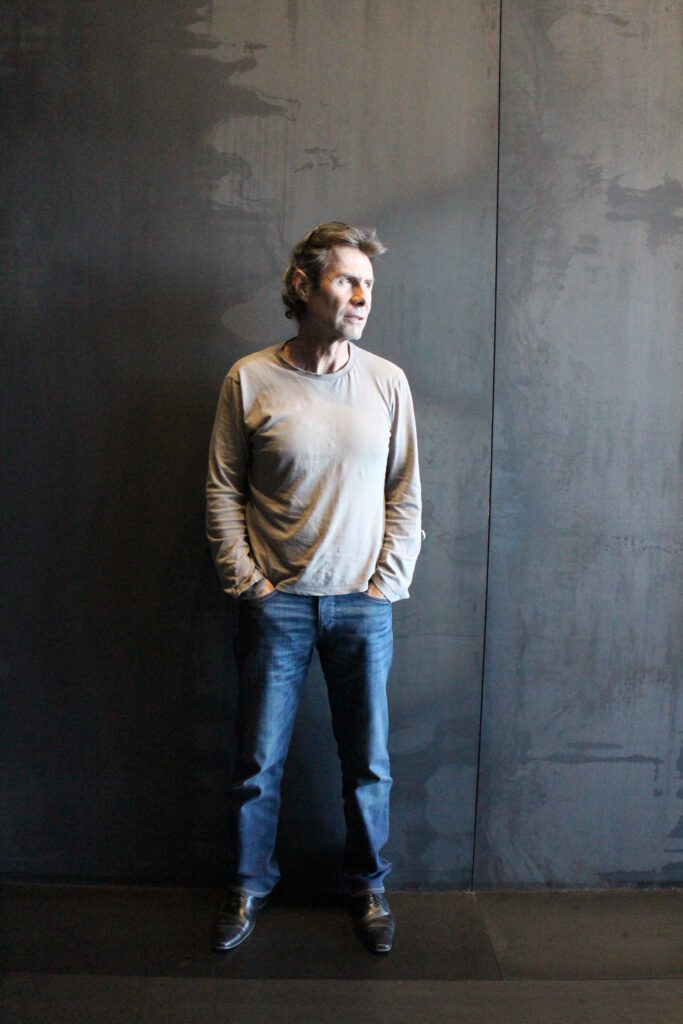
Né en 1961, Eric Béridon vit et travaille dans le sud de la France. Victime d’un accident de moto à vingt ans, il reste immobilisé plusieurs mois, au cours desquels nait sa réflexion artistique. En 1991, il réalise ses premiers travaux, obtient en 1993 le 1er prix des jeunes peintres au Salon d’automne de la Loire (Blois) et en 2001 le Prix Art Dialogue–Paris au 18ème RDV des Jeunes Plasticiens (La Garde). Il développe depuis une œuvre inclassable, à la croisée des arts plastiques, de la philosophie et des sciences. Ses œuvres ont été présentées dans de nombreux centres d’art et galeries, en France et à l’étranger, notamment à La Napoule Art Foundation (2025), à la Fondation Fernet-Branca (2020), au Courtauld Institute of Art (2012-2013), à la galerie Bowman de Londres, et sont présentes au sein de nombreuses collections privées.
Eric Béridon relentlessly questions the meaning of life, exploring the link between the visible and the invisible, the instinctive and the cognitive, and seeks to unite in a single creative process the materiality of the body and the abstraction of the mind, without opposing them. In his works, the body is matter at its origin (traces of fire remains, metal, ochre stones, etc.). Over the years, the artist’s pursuit has been to confront or associate this matter with a plastic representation of the spirit (lines, geometric shapes, etc.), everything that is culturally produced by humankind, the tendency toward abstraction that distinguishes humans from animals, and which might offer meaning to human existence in the face of the surrounding universe. Light, both wave and particle, as a medium in its own right in Beridon’s work, embodies the connection between natural elements (the body) and more conceptual ones (the mind). From this perspective, culture does not dominate nature, but listens to it. It acts as a bridge, a space of silent junction between the world and our perception. “Is it matter that creates the mind or the mind that comes to impregnate matter?” This question remains at the centre of the artist’s approach. To address it, he must strive for work that is not additive, but subtractive, purifying his gesture, with the ultimate work being one that reveals the essential, the invisible with almost nothing.
« I seek , farther than the visible, the essence of life beyond the existence. » Eric Béridon
Born in 1961, Eric Béridon lives and works in the south of France. After suffering a motorcycle accident at the age of twenty, he was immobilised for several months, during which time his artistic reflection began to take shape. In 1991, he produced his first works, winning first prize for young painters at the Salon d’Automne de la Loire (Blois) in 1993 and the Art Dialogue–Paris prize at the 18th RDV des Jeunes Plasticiens (La Garde) in 2001. He has since developed an unclassifiable body of work, at the crossroads of visual arts, philosophy and science. His works have been exhibited in numerous art centres and galleries in France and abroad, including La Napoule Art Foundation (2025), the Fondation Fernet-Branca (2020), the Courtauld Institute of Art (2012-2013), the Bowman gallery in London, and are present in numerous private collections.